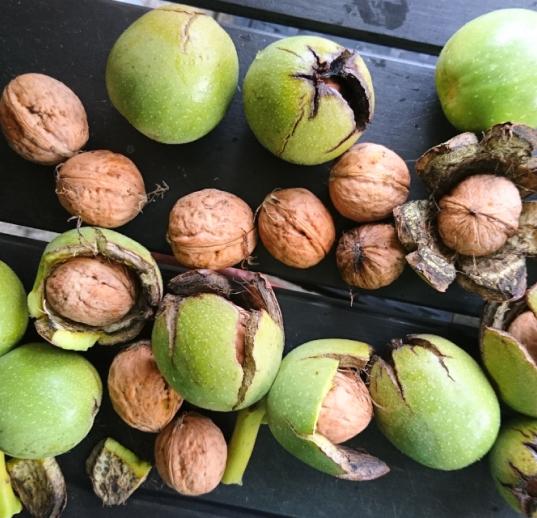
Commercial walnut growing barely exists in the Baltic climate, so Latvian bakeries, confectioners and organic shops work with imported kernels. Central Asia is part of the walnut’s native range, and Uzbekistan supplies kernels from the Fergana Valley, Tashkent region and the foothills of Surkhandarya. For an organic product, origin and price are only half of the deal: the lot also has to carry EU organic certification and pass the import check in Latvia.
This guide explains what the organic label requires for walnut kernels, which documents travel with the shipment and which quality limits Latvian buyers verify before payment. Prices, bulk formats and supplier selection for conventional walnuts are covered in our guide to buying bulk walnuts in Latvia.
What “organic” means for walnuts imported into the EU
Since 1 January 2022, organic production and imports in the EU follow Regulation (EU) 2018/848. A walnut lot can be sold in Latvia as organic only if every stage, from the orchard to drying, cracking, sorting and packing, is inspected by a control body that the European Commission recognises for the exporting country.
Wild-collected walnuts can qualify too. The collection area must be clearly defined and must not have been treated with non-authorised substances for at least three years before harvest. This route is used in Central Asia, where many walnut trees grow along field borders and in foothill areas rather than in intensive orchards.
The physical standard stays the same. An organic kernel is graded by the same colour, size and moisture rules as a conventional one. What changes is the paper trail and, in practice, zero tolerance for residues of non-authorised pesticides.
Uzbek walnut kernels: which grades buyers ask for
Sultan Agro sources walnut kernels from partner farms in Namangan, Surkhandarya and Tashkent regions. The harvest starts in October, and a 20-tonne lot is usually prepared for shipment within 12–14 days. Three colour grades are available:
- Extra: the lightest, uniform halves for retail packs and premium confectionery;
- Yellow: light kernels for bakeries, granola and muesli producers;
- Amber: darker kernels with a stronger taste for fillings, pastes and industrial baking.
Shapes range from whole “butterfly” halves to quarters and pieces. Specifications and packing options are listed on the bulk walnut kernels page.

Documents for an organic walnut shipment to Latvia
An organic consignment cannot be released for free circulation in the EU without an electronic certificate of inspection (COI) in the TRACES system. The rules for these checks are set by Delegated Regulation (EU) 2021/2306. The exporter’s control body issues the COI, and in Latvia it is verified by the Food and Veterinary Service (PVD) before customs clearance.
| Document | Issued by | What it proves |
|---|---|---|
| Organic certificate of the exporter | Control body recognised by the European Commission | The supplier and its processing are inspected under organic rules |
| Certificate of inspection (COI) in TRACES | The same control body, for each consignment | This specific lot is organic; required for release in the EU |
| Statement on origin (REX) | Exporter registered in the REX system | Uzbek origin for the GSP+ tariff preference |
| Laboratory report | Accredited laboratory | Aflatoxins, pesticide residues and moisture are within EU limits |
| Invoice, packing list, CMR | Exporter and carrier | Value, net and gross weight, lot numbers, transport details |
Uzbekistan has held GSP+ status in the EU since April 2021. The preference removes import duty on most of its agricultural exports, but only with a valid statement on origin. Before signing a contract, check the current rate for walnut kernels (CN code 0802 32 00) in the EU TARIC database.
Quality limits Latvian buyers check before payment
Aflatoxin is the strictest number in a walnut contract. Regulation (EU) 2023/915 limits aflatoxin B1 in tree nuts sold directly to consumers to 2.0 µg/kg and the sum of aflatoxins to 4.0 µg/kg. Kernels that will be sorted before sale may contain up to 5.0 and 10.0 µg/kg.
| Parameter | Typical requirement | Reference |
|---|---|---|
| Aflatoxin B1, ready-to-eat kernels | ≤ 2.0 µg/kg | Regulation (EU) 2023/915 |
| Sum of aflatoxins B1, B2, G1, G2 | ≤ 4.0 µg/kg | Regulation (EU) 2023/915 |
| Moisture of kernels | ≤ 5.0 % | UNECE standard DDP-02 |
| Colour classes | Extra light, light, light amber, amber | UNECE standard DDP-02 |
| Pesticide residues | Within EU maximum levels; none of substances not allowed in organic farming | Regulation (EC) 396/2005, Regulation (EU) 2018/848 |
For organic lots, residues are the sensitive point. A detected residue of a substance not allowed in organic farming starts an official investigation, and the lot cannot be sold as organic until the cause is clear. That is why buyers ask for a multi-residue analysis of each lot rather than one certificate for the whole season.

How an organic walnut order runs: from request to Riga
- The buyer sends a specification: colour grade, shape, volume, packing and the organic requirement.
- We confirm which lots and certificates are available and send an offer on Incoterms 2020 terms, usually FCA Tashkent or DAP Riga.
- Samples and the laboratory report go to the buyer for approval.
- The lot is packed, often in 10 kg cartons with vacuum-sealed liners, and loaded at about 20 tonnes per truck.
- The control body issues the COI in TRACES, and the goods are cleared in Latvia after the PVD check.
Kernels keep their quality for about 12 months at 0…+5 °C and 55–65 % relative humidity, away from strong odours. Warm storage speeds up rancidity: the kernel darkens and the taste turns bitter long before the best-before date.
Mistakes that delay organic walnut imports
- Buying a lot certified under a national organic standard that the EU does not recognise.
- Dispatching the truck before the COI is issued in TRACES: the goods then wait at the border.
- Accepting a seasonal lab report instead of an analysis of the specific lot.
- Loading organic and conventional kernels together without separate, clearly labelled packing.
Frequently asked questions
Can walnuts from Uzbekistan be sold as organic in Latvia?
Yes, if the lot is certified by a control body that the European Commission recognises for Uzbekistan and each consignment has an electronic certificate of inspection in TRACES. Without the COI, the walnuts can only be sold as conventional.
What aflatoxin limit applies to walnut kernels in the EU?
For walnuts sold directly to consumers: 2.0 µg/kg of aflatoxin B1 and 4.0 µg/kg of total aflatoxins under Regulation (EU) 2023/915. For kernels that will be sorted before sale: 5.0 and 10.0 µg/kg.
Is there import duty on Uzbek walnuts in the EU?
Uzbekistan has had GSP+ status in the EU since April 2021, which removes duty on most of its agricultural goods when the exporter provides a valid statement on origin. Check the current rate for CN 0802 32 00 in TARIC before signing a contract.
How long does it take to prepare a 20-tonne lot?
About 12–14 days after the specification and samples are approved. The new crop is harvested in October, so the widest choice of grades is available from November.
How should organic walnut kernels be stored?
At 0…+5 °C and 55–65 % relative humidity, in sealed packaging and separately from conventional goods. Under these conditions kernels keep their colour and taste for about 12 months.
Which colour grade suits a bakery?
Bakeries and muesli producers usually choose Yellow or Amber kernels in quarters and pieces. They work the same in dough and cost less than Extra halves, which go mainly into retail packs.
To get an offer for organic or conventional walnut kernels with delivery to Riga, send your specification through the contact page or write to info@sultanagro.uz. We will reply with available grades, documents and delivery terms.
If you have questions about the format or do not know what to choose, leave your number — we will call you to answer all your questions.